
Why Does LLM Traffic Convert Differently? How to Optimise for AI Search
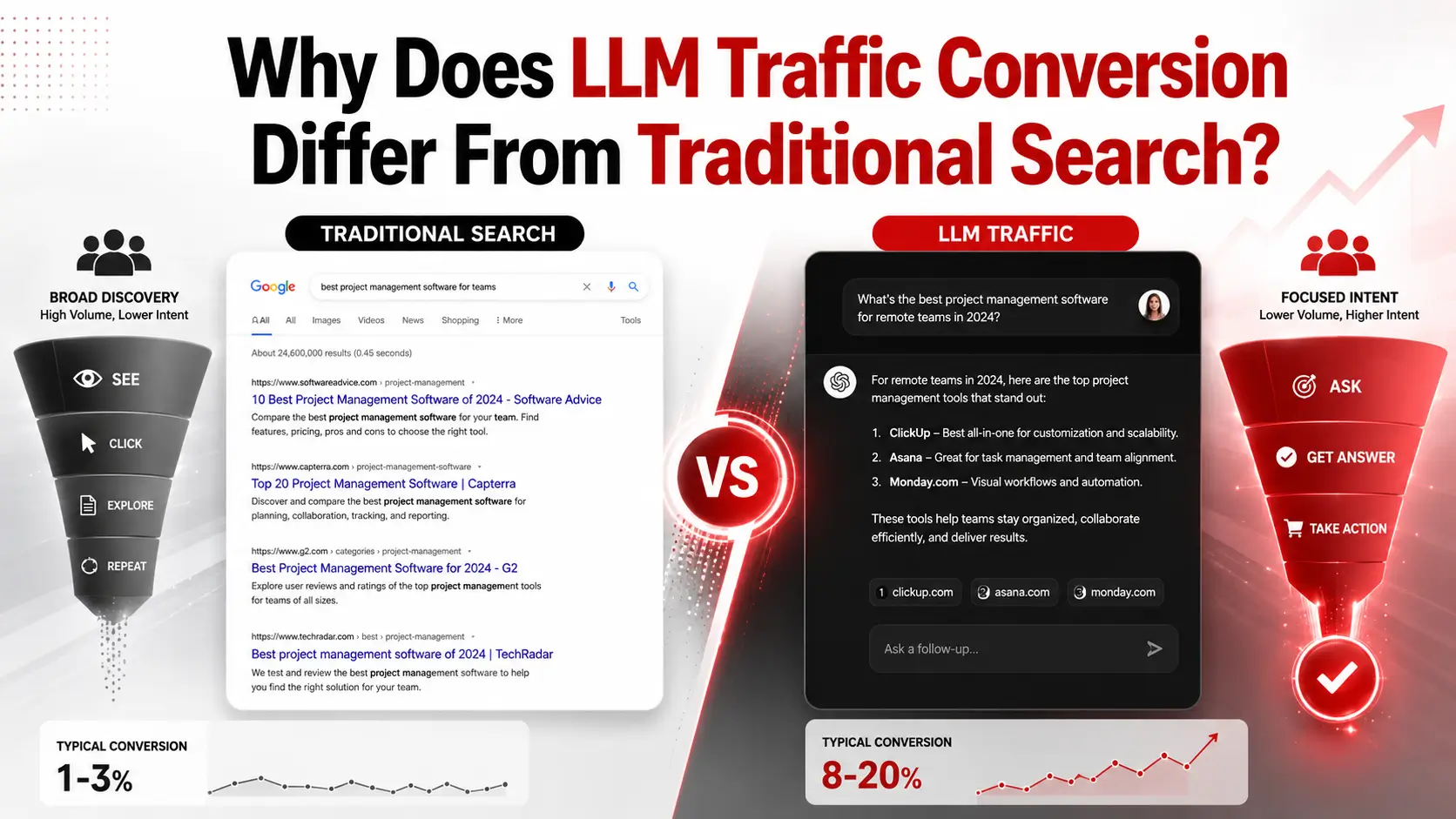
An AI visitor may arrive at your website after asking ChatGPT or another AI tool to research, compare, or recommend a solution. That makes LLM traffic conversion different from traditional search in some cases.
The visitor may already know what they need. They may also have seen your brand mentioned before clicking.
However, AI traffic does not automatically convert better. The outcome depends on intent, industry, landing page quality, and the user's stage in the buying journey.
What Makes AI Search Visitors Different?
Traditional search usually starts with a list of links. Users then visit several websites to compare their options.
AI search can change that journey.
A user might first ask an AI assistant:
“What are the best options for improving my website's visibility?”
The AI may explain the options, compare approaches, and recommend relevant sources. The user then visits one of those websites with more context than a typical searcher may have.
This means AI search traffic can sometimes contain highly informed visitors.
The volume of AI referrals is also growing. Search Engine Land reported in July 2026 that ChatGPT accounted for 92.4% of trackable LLM referral traffic in its dataset, with referral traffic growing 12.8 times over 19 months.
However, there is also a downside. AI systems can answer questions without sending users to websites at all.
So businesses should focus on qualified AI search visitors, not simply increasing AI referral traffic.
Why Can ChatGPT Traffic Conversion Be Different?
ChatGPT traffic conversion can vary because the user journey often begins with a conversation.
For example:
- Low-intent question: “What is GEO?”
- Higher-intent question: “Which agency can help my business improve visibility in AI search?”
The second user is much closer to taking action.
That context can influence what happens after the click.
Recent Similarweb data shows that ChatGPT referral traffic had a 7.1% conversion rate, putting it close to paid search at 7.8% and ahead of several other major traffic sources. However, conversion performance varies by website and industry.
Therefore, there is no universal AI traffic conversion rate that every business should expect.
The better approach is to measure your own data.
How Can You Optimise Your Website for AI Search Visitors?
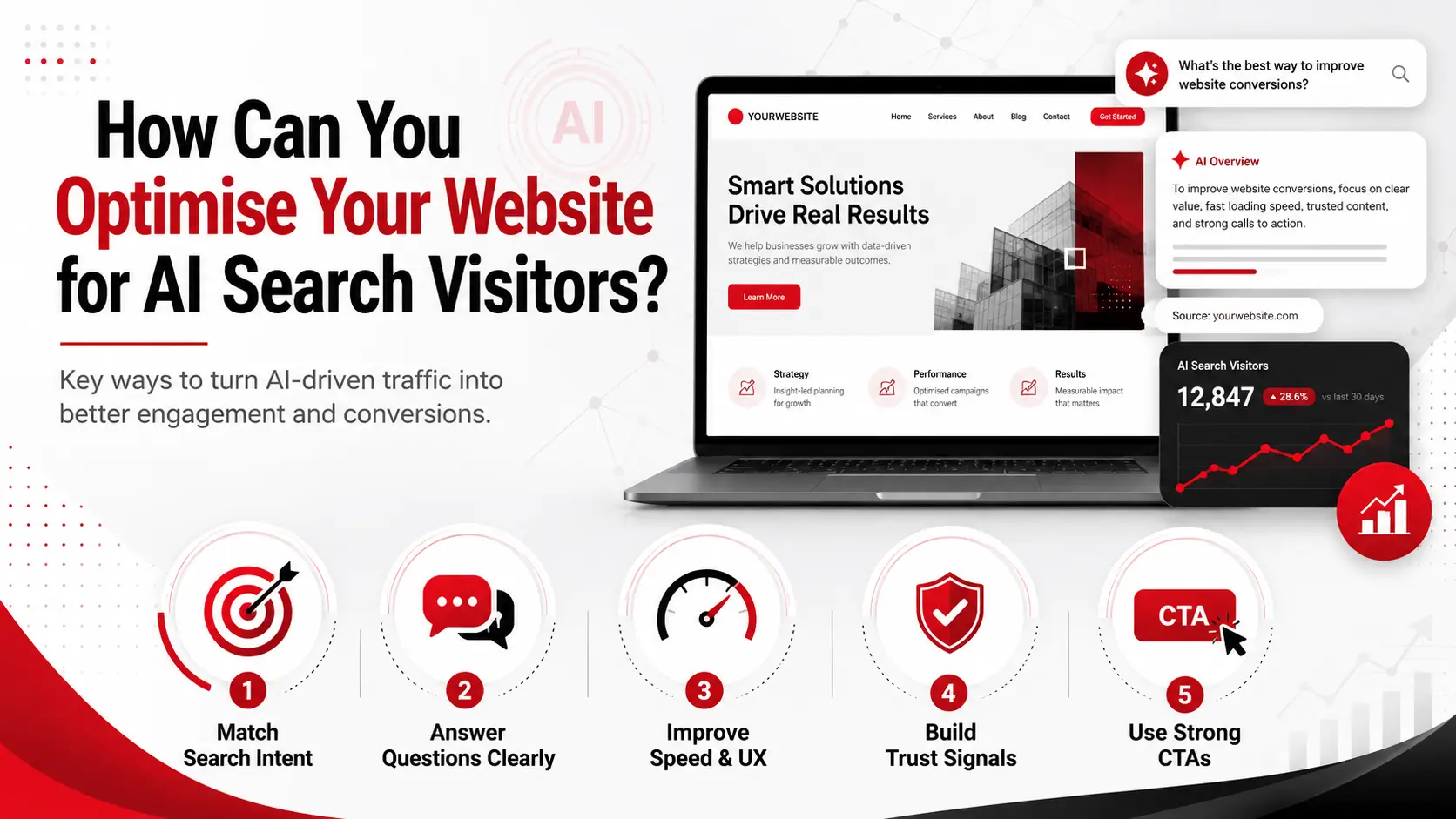
The first step is simple: make sure visitors immediately understand where they are and what you offer.
Your landing page should clearly communicate:
- What you provide
- Who it is for
- What problem it solves
- How the process works
- Why customers should trust you
- What they should do next
Avoid forcing visitors to search through several pages for basic information.
An AI-referred visitor may already have a specific question in mind. Your website should answer it quickly.
Want to Improve Your AI Search Visibility?
A strong AI search strategy starts with useful content, clear website structure, and a strong understanding of your audience.
Explore GEO ServicesHow Does Content Quality Affect LLM Traffic Conversion?
Content plays two roles.
First, it can help your business become visible when people research relevant topics through search and AI platforms.
Second, it can help visitors decide whether your business is worth contacting.
For example, a useful service page can explain:
- Who the service is suitable for
- What the process involves
- What customers can expect
- Common questions
- Potential limitations
- Available alternatives
- How to get started
This is more useful than simply repeating a keyword throughout the page.
Google's current guidance for AI Search emphasises unique, helpful and trustworthy content created for people, rather than content produced simply to manipulate AI visibility.
What Should You Include on Pages Receiving AI Referral Traffic?
Think about what a visitor needs immediately after arriving.
Clear answers
Use straightforward headings and explain important information without unnecessary jargon.
Evidence
Where appropriate, include case studies, qualifications, reviews, original research or relevant supporting evidence.
Transparent information
Do not hide important details behind vague claims.
Explain what your service does and, where relevant, what it does not do.
A clear next step
Give visitors an obvious action such as requesting a consultation, viewing a service or contacting your team.
This creates a smoother path from AI search visitors to potential customers.
How Can LLM SEO and GEO Support Conversions?
LLM SEO and GEO focus on visibility across AI-driven search experiences, but visibility is only the beginning.
Getting mentioned by an AI system does not guarantee a lead.
The website experience after the click matters just as much.
A useful approach is:
Relevant question → Helpful content → AI visibility → Relevant landing page → Trust → Conversion
This connects AI search optimisation with the wider customer journey.
Google's current documentation also makes an important point: there is no separate set of “AI Search hacks” that replaces good SEO. Its generative Search features continue to rely on core Search ranking and quality systems.
How Should You Measure Your AI Traffic Conversion Rate?
Do not measure AI traffic only by sessions.
Instead, monitor:
- AI referral traffic
- Landing pages
- Engagement
- Leads
- Sales
- Conversion rate
- Revenue
- Assisted conversions
For example, 300 AI visitors that produce 15 qualified enquiries may be more valuable than thousands of visitors who take no action.
Also remember that attribution can be complicated.
A person might discover your brand through ChatGPT, return through Google several days later, and eventually convert through a direct visit.
Therefore, AI referral traffic should be viewed as part of the wider customer journey.
What Mistakes Can Reduce AI Search Conversions?
Several mistakes can make AI traffic less valuable.
Sending visitors to generic pages
If an AI recommendation relates to a specific service, sending the visitor to a generic homepage can create unnecessary friction.
Writing only for AI systems
Content should answer real user questions rather than being written around artificial prompts or excessive keyword variations.
Making unsupported claims
Avoid statements such as “best”, “number one” or “guaranteed results” unless you can substantiate them.
Ignoring website experience
Slow pages, confusing navigation, and unclear calls to action can affect conversions regardless of where visitors came from.
Chasing traffic instead of intent
More AI visitors are not necessarily better. Focus on whether those visitors are relevant and whether they take meaningful actions.
How Can Businesses Turn AI Search Visitors Into Customers?
The key is to connect visibility with usefulness.
Start by understanding the questions your customers actually ask. Then create content that answers those questions clearly.
Next, connect informational content to relevant service pages.
Finally, make those service pages trustworthy, easy to understand, and simple to navigate.
This approach supports LLM traffic conversion without relying on artificial AI-search tactics.
What Is the Future of LLM Traffic Conversion?
AI search is changing how people discover and evaluate businesses.
However, the fundamentals remain familiar.
People still need useful information. They still need reasons to trust a business. And they still need a simple path to take action.
That is why LLM traffic conversion should not be treated as a completely separate marketing discipline.
Instead, businesses should connect AI visibility, useful content, strong landing pages, technical accessibility, and conversion measurement.
Google's current AI Search guidance supports this broader approach, noting that established SEO best practices remain relevant for AI-powered Search experiences.
Have Questions About AI Search?
Want to understand how AI search could affect your website traffic and conversions? Contact Spotlight GB for practical guidance on your next steps.
Contact UsConclusion
LLM traffic conversion is influenced by more than where a visitor comes from.
AI users may arrive with stronger context, clearer questions, or a shorter list of options. But that does not guarantee a conversion.
The businesses most likely to benefit are those that understand user intent, answer questions clearly, demonstrate trust, and make the next step easy.
The goal is not simply to attract AI traffic. The goal is to make every relevant AI visitor more likely to find the answer, trust the business and take the right next step.
Frequently Asked Questions
Why does LLM traffic convert differently?
LLM visitors may arrive after researching a topic through an AI assistant. As a result, some visitors may already understand their problem and be further along in the buying journey.
Is AI search traffic better than Google traffic?
Not automatically. AI search traffic can have different intent, but its quality varies by industry, platform and query. Businesses should compare leads, sales and revenue rather than traffic alone.
How can I track ChatGPT referral traffic?
Use your analytics platform to identify AI referral sources where possible. Then compare landing pages, engagement and conversions with other traffic sources.
What is a good AI traffic conversion rate?
There is no single benchmark that applies to every business. Your conversion rate will depend on your industry, offer, audience, and measurement method.
Does GEO improve conversions?
GEO primarily aims to improve visibility in AI-powered search experiences. Better visibility can support conversions when AI-referred users reach relevant and trustworthy pages.
Spotlight GB
Editorial Team


