
Google AI Link Attribution: What It Means for SEO and GEO in 2026
What if your content could appear in AI search results even before users visit your website? That's exactly where Google AI Link Attribution is changing the future of search. With enhanced citations in AI Overviews and AI Mode, Google is making source attribution more visible and encouraging users to explore original content.
For businesses and marketers, this means greater opportunities to build authority, earn AI citations, and increase organic visibility. Here's what these updates mean and how to optimise your content for them.
Why Google Updated AI Link Attribution
When Google introduced AI Overviews, many website owners raised a common concern: users could receive complete answers directly on the search results page without clicking through to external websites.
While AI-generated answers improved convenience, they also reduced opportunities for publishers to attract organic traffic.
Google's latest improvements aim to create a better balance between helping users find quick answers and recognising the websites that produce trustworthy information.
The update focuses on three important goals:
- Improve transparency by showing where information comes from.
- Help users evaluate the credibility of AI-generated answers.
- Encourage users to continue exploring authoritative websites.
Rather than replacing publishers, Google appears to be positioning AI as a discovery tool that connects users with reliable sources.
What's New in Google AI Link Attribution?
Google has introduced several enhancements that improve how sources appear throughout AI Mode and AI Overviews.
1. Inline Citations Beside AI Responses
Instead of placing all references at the bottom of an AI-generated answer, citations now appear next to the relevant information.
This provides immediate context and allows users to understand exactly which source supports a particular statement.
For publishers, this increases brand visibility because users can clearly associate valuable information with its source.
2. Hover Previews on Desktop
Desktop users can now hover over many citations before opening a webpage.
These previews display useful information about the source, helping users decide whether they want to learn more.
This small change improves user confidence and may increase the likelihood of qualified visitors clicking through.
3. Stronger Publisher Recognition
Google is placing greater emphasis on publisher identity.
News organisations and recognised publishers now receive more prominent branding within AI-generated responses. In some situations, subscription information also appears alongside citations.
This makes it easier for users to recognise trusted publications and distinguish them from less authoritative sources.
For businesses investing in content marketing, brand recognition is becoming an increasingly important ranking signal beyond keywords alone.
How Google AI Link Attribution Impacts SEO
The fundamentals of SEO have not changed. Google still rewards content that is accurate, useful, and written for people.
However, Google AI Link Attribution changes how users discover that content.
Instead of competing only for traditional organic rankings, websites now have another opportunity to earn visibility by becoming a cited source within AI-generated answers.
This creates several new advantages:
- Greater Brand Exposure: Even if users do not immediately click your website, seeing your brand repeatedly cited within AI responses builds familiarity and trust. Over time, these brand impressions can influence future searches and purchasing decisions.
- Higher-Quality Traffic: Users who choose to click a citation after reading an AI response often have stronger intent. They already understand the topic and want deeper information, making them more engaged visitors compared to users who simply skim search results.
- Authority Becomes More Valuable: Google's AI systems rely on trustworthy information. Businesses that consistently publish original research, practical advice, case studies, and expert insights are more likely to become citation-worthy sources. This reinforces the importance of Experience, Expertise, Authoritativeness, and Trustworthiness (E-E-A-T) across every piece of content.
Strengthen Your Organic Visibility
Build long-term growth with SEO strategies that improve rankings, attract qualified traffic, and support your business goals.
Explore Our SEO ServicesHow to Optimise Your Content for AI Citations
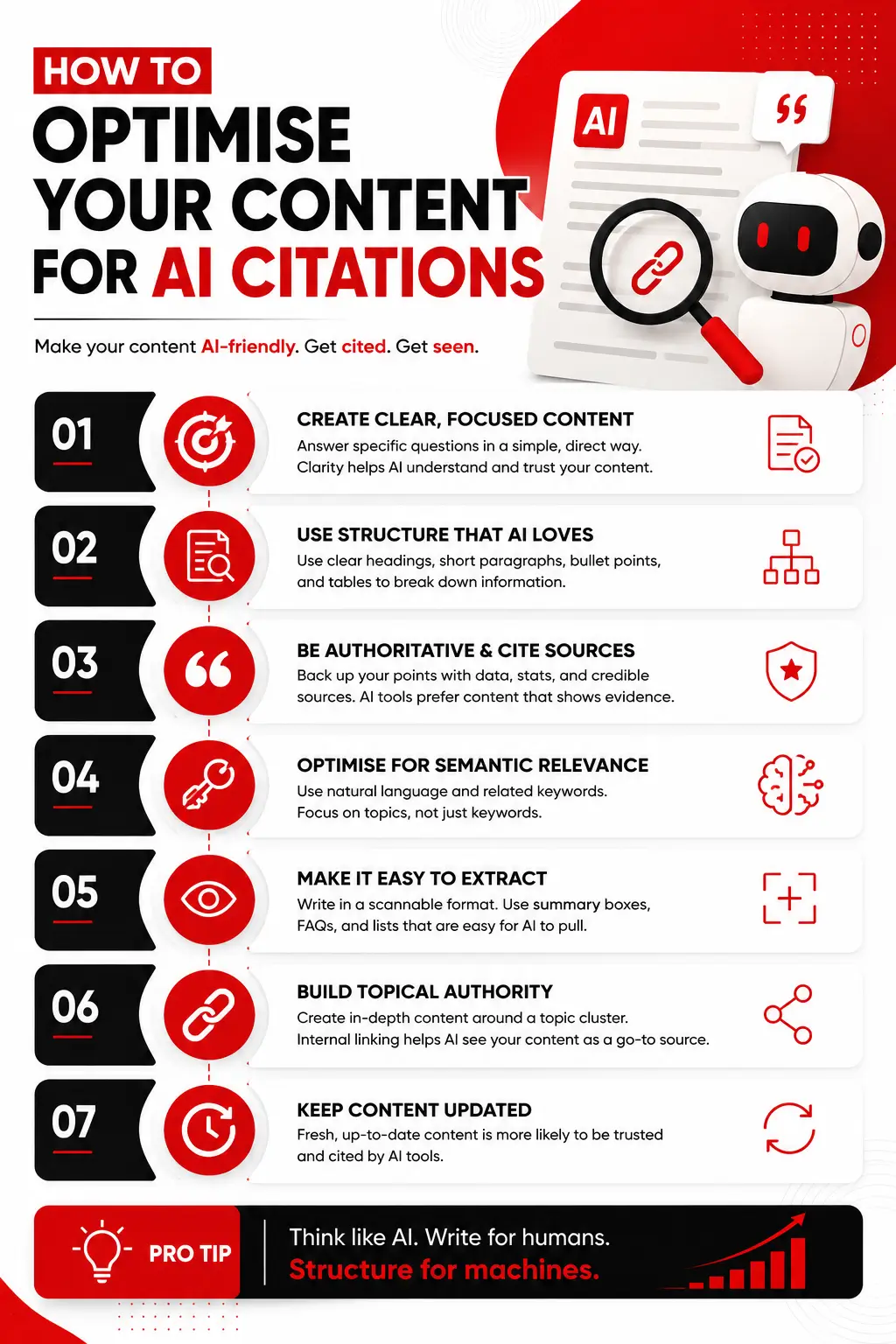
The latest updates reinforce a simple message: genuinely useful content has the best chance of being referenced by Google's AI systems. Instead of trying to optimise specifically for AI, focus on creating content that demonstrates expertise, answers search intent, and provides value beyond what already exists online.
Publish Original Insights
AI systems can summarise existing information, but they still rely on sources. If your content includes firsthand experience, industry research, customer case studies, proprietary data, or expert opinions, it becomes far more valuable than content that simply repeats what others have already published.
Whenever possible, include:
- Original statistics or survey findings
- Real client success stories
- Expert commentary
- Step-by-step guides based on experience
- Practical examples and actionable advice
Original content is not only more useful for readers, but it is also more likely to earn citations in AI-generated responses.
Strengthen Your E-E-A-T Signals
Google continues to prioritise content that demonstrates Experience, Expertise, Authoritativeness, and Trustworthiness (E-E-A-T).
To strengthen these signals:
- Add clear author information and credentials.
- Support claims with reliable sources.
- Keep articles updated as information changes.
- Include accurate facts rather than exaggerated marketing claims.
- Maintain a consistent publishing schedule focused on your area of expertise.
These trust signals help both users and AI systems evaluate the credibility of your content.
Want to learn more about improving content credibility? Read our guide on E-E-A-T SEO: What It Is and Why It Matters for Top Rankings to discover practical strategies for building trust and improving your search performance.
Structure Content for AI Readability
AI systems process information more effectively when it is organised clearly.
Use:
- Descriptive headings (H2 and H3)
- Short paragraphs
- Bullet points where appropriate
- Tables for comparisons
- Direct answers to common questions
- Simple, easy-to-understand language
Well-structured content is easier for both search engines and readers to understand, increasing its chances of being referenced.
Build Strong Entity Signals
Modern SEO is no longer only about keywords. Google also understands entities such as people, organisations, locations, products, and services.
Strengthen your entity signals by:
- Using consistent business information across your website.
- Creating detailed service pages.
- Linking related content together.
- Referencing recognised industry terms naturally.
- Implementing structured data where relevant.
Strong entity optimisation helps Google understand who you are and what your website is known for.
GEO and SEO Work Better Together
Some marketers see Generative Engine Optimisation (GEO) as a replacement for traditional SEO. In reality, they complement each other.
SEO helps your content rank in search results, while GEO improves its chances of appearing in AI-generated answers across platforms like Google AI Overviews, ChatGPT, Gemini, and other conversational search tools.
A successful digital strategy combines both approaches by focusing on:
- Helpful, people-first content
- Strong topical authority
- Internal linking
- Structured content
- Clear expertise
- Technical SEO best practices
Businesses that invest in both SEO and GEO are better positioned for the future of search.
How to Measure Success in AI Search
As AI-powered search continues to evolve, businesses should monitor more than keyword rankings.
Consider tracking:
- Organic impressions
- Click-through rate (CTR)
- Referral traffic
- Branded search growth
- User engagement metrics
- Conversion rates from organic visitors
These insights provide a clearer picture of how AI search is influencing your visibility and website performance.
As Google's reporting capabilities continue to improve, marketers should regularly review Search Console and analytics data to identify emerging trends and opportunities.
Common Mistakes to Avoid When Optimising for AI Search
Many businesses are rushing to optimise for AI search, but some approaches can do more harm than good.
Avoid these common mistakes:
- Publishing AI-generated content without expert review.
- Creating multiple pages targeting the same keyword.
- Overusing keywords instead of writing naturally.
- Making unsupported claims or exaggerating expertise.
- Neglecting regular content updates.
- Ignoring user intent in favour of search engine optimisation alone.
Google's helpful content systems continue to reward websites that prioritise real users over algorithms.
Need Help Future-Proofing Your SEO?
Whether you're improving existing content or building a new AI-ready strategy, our experts can help you stay ahead of search changes with proven SEO and GEO solutions.
Contact Our SEO ExpertsConclusion
Google AI Link Attribution highlights Google's growing focus on transparency and quality content. As AI search evolves, businesses that publish original, trustworthy, and well-structured information will have greater opportunities to earn citations and attract qualified traffic. Combining strong SEO with GEO will help your content remain visible across both traditional and AI-powered search experiences.
Frequently Asked Questions
What is Google AI Link Attribution?
It credits sources within AI-generated search results using visible citations, publisher information, and contextual links.
Does Google AI Link Attribution affect SEO?
Yes. It creates more opportunities for authoritative content to gain visibility through AI-generated search responses.
How can I earn AI citations?
Publish original, trustworthy, well-structured content that clearly answers user questions and demonstrates expertise.
Is GEO different from SEO?
Yes. GEO targets AI search visibility, while SEO focuses on improving rankings in traditional search results.
Should I change my content strategy?
Focus on helpful, authoritative content with clear structure, updated information, and strong E-E-A-T signals.
Why did Google improve AI attribution?
To increase transparency, recognise content creators, and encourage users to visit original, trustworthy sources.
Spotlight GB
Editorial Team


