
Can AI Search Replace Google? What Businesses Need to Know in 2026
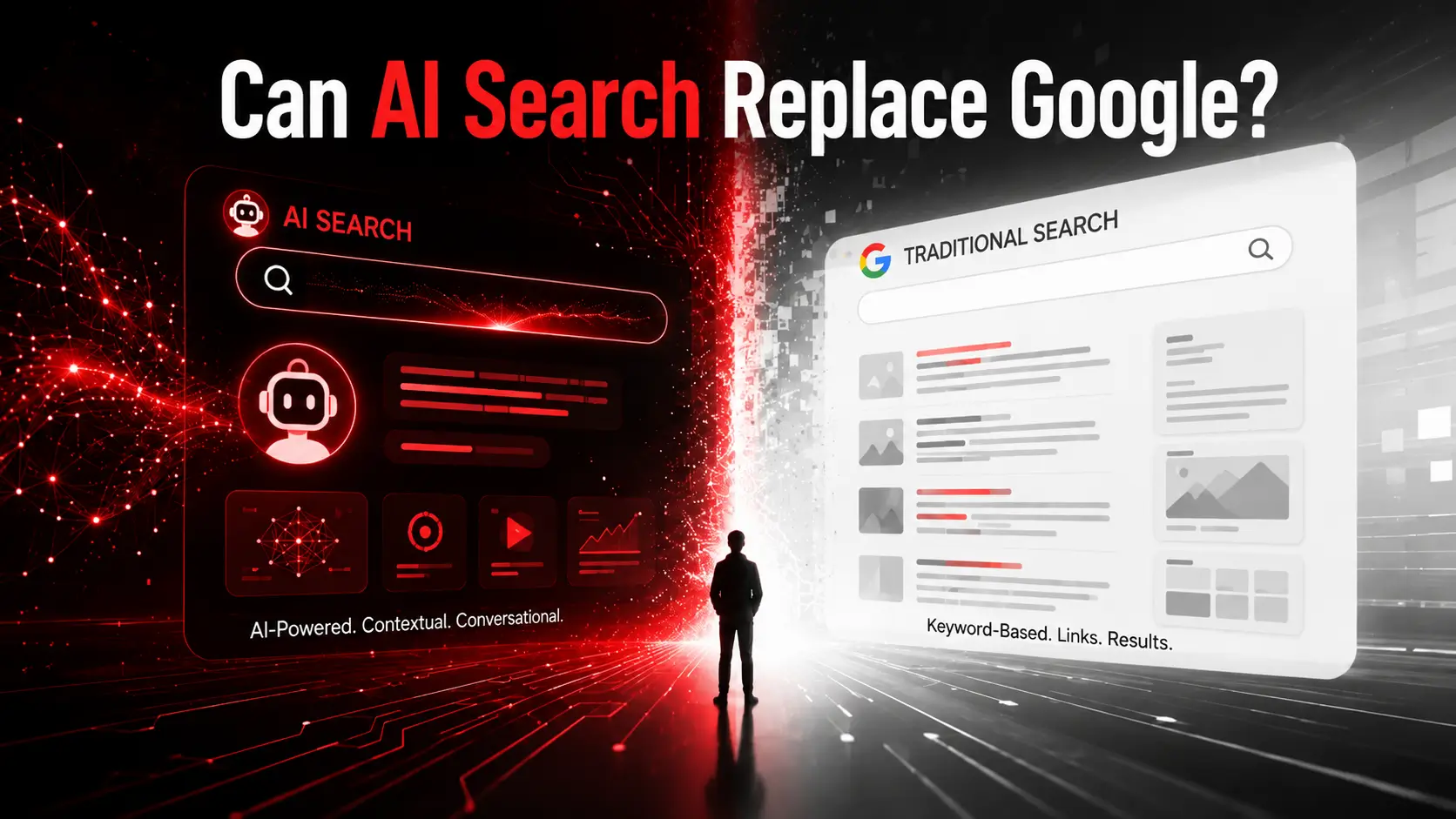
For more than two decades, the formula for online growth was simple: create content, rank on Google, and attract steady organic traffic. That model is now weakening as a growing share of searches end without clicks, with users getting instant answers directly on the results page or through AI tools. This shift is forcing businesses to rethink how visibility actually works in the digital space.
This raises an important question: will AI search replace Google, or is search simply evolving? No, Google is not disappearing, but user behavior is clearly changing. To survive, businesses must look past old keyword tracking and embrace AI search. This shift requires a brand-new playbook called Generative Engine Optimisation (GEO).
Will AI Search Replace Google?
No, AI search is unlikely to completely replace Google in the near future.
Instead, search is evolving from a link-based experience to an answer-based experience. Users increasingly expect instant, conversational responses rather than pages of blue links. As a result, businesses must optimise not only for traditional search engines but also for AI systems that generate answers directly.
The future belongs to companies that can be discovered, cited, and recommended by both search engines and AI platforms.
How is the Search Landscape Changing in 2026?
A growing percentage of searches now end without users clicking a website. Instead, people receive answers directly from search results, AI assistants, or AI-generated summaries.
This trend is driven by:
- AI-generated responses
- Voice search adoption
- Conversational search behavior
- Instant answer expectations
- AI assistants integrated into browsers and apps
For businesses, this means visibility is no longer limited to ranking on page one of Google.
Today, being cited inside an AI response can be just as valuable as earning a traditional search ranking.
Traditional Search vs. AI Search Engines: The Current Landscape
| Traditional Search | AI Search |
|---|---|
| User enters keywords | User asks a question |
| Search engine displays links | AI provides direct answers |
| User visits multiple websites | AI summarises multiple sources |
| Focus on rankings | Focus on citations and recommendations |
| Clicks are the primary goal | Trust and visibility are the primary goals |
The 2026 Baseline: Studies show that when an AI summary appears on Google, only about 8% of users click a traditional organic link below it. The rest get their answer and leave.
How Does AI Search Work?
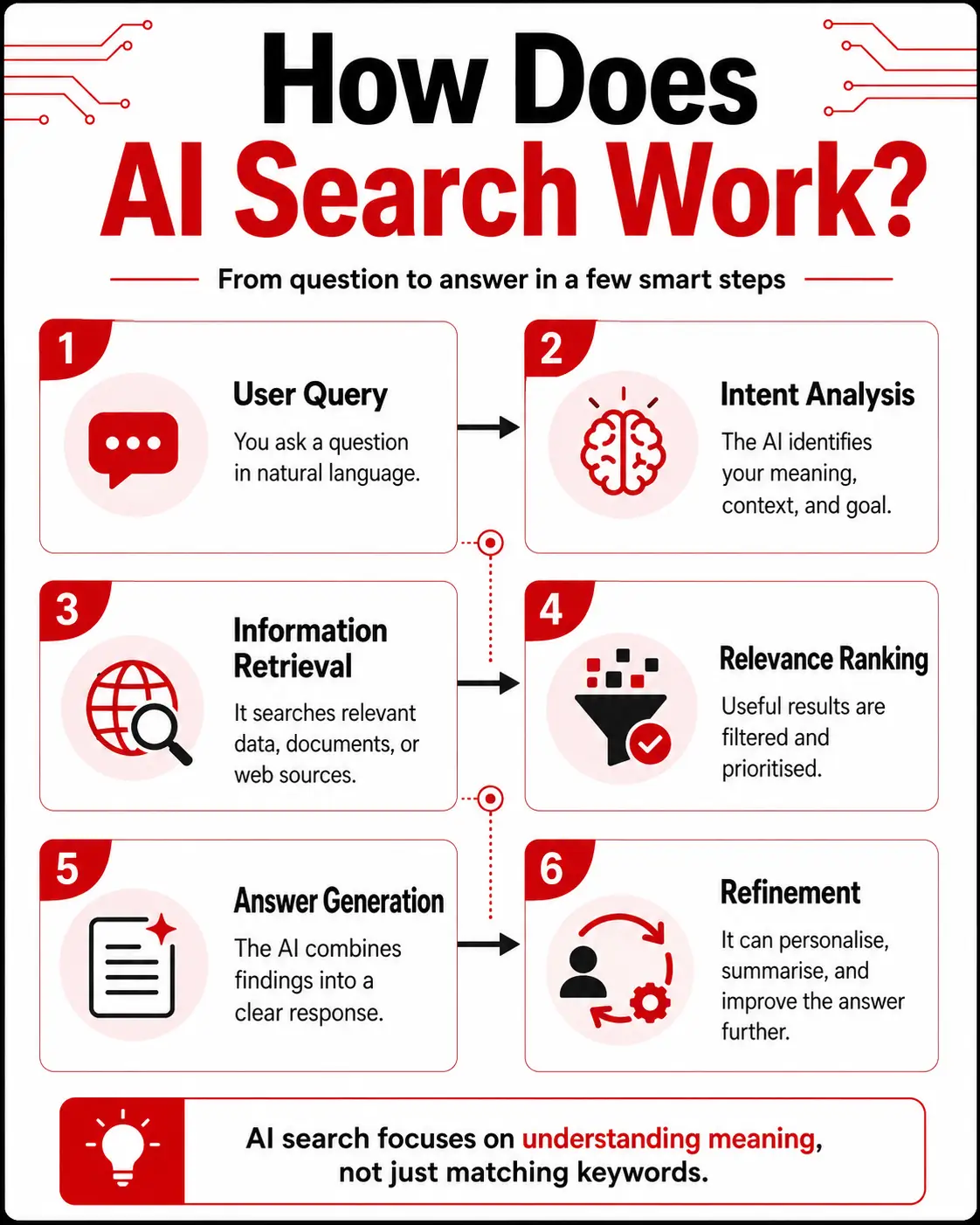
Many business owners ask, "How does AI search work?"
AI-powered search systems use large language models (LLMs) to understand a user's intent, gather information from multiple sources, and generate a concise response.
Instead of matching exact keywords, AI evaluates:
- Context
- User intent
- Source credibility
- Topic relevance
- Content quality
This creates a more conversational experience where users can ask complex questions and receive detailed answers instantly.
For businesses, this means content must be understandable not only by search engine crawlers but also by AI models.
What Are the Leading AI Search Engines Today?
| Tool | What it does best |
|---|---|
| Google AI Mode (Gemini) | Best for general users. It provides multi-source "Deep Search" research reports directly inside traditional search results. |
| ChatGPT-based search | Conversational answers and explanations |
| Perplexity-style engines | Real-time sourced answers |
| Google AI Overviews | Blended AI + traditional results |
| Bing AI search | Integrated AI responses in web search |
What Are Zero-Click Searches and Why Should Businesses Care?
One of the biggest changes businesses face is the rise of zero-click searches.
A zero-click search occurs when users receive the information they need without visiting a website.
Examples include:
- AI-generated summaries
- Featured snippets
- Knowledge panels
- AI chatbot responses
This trend can reduce top-of-funnel traffic, especially for websites publishing basic informational content.
A simple article answering "What is SEO?" may never receive a click because the answer already appears on the screen.
SEO is Not Dying, It's Evolving into GEO And AEO
Traditional SEO still matters, but it is no longer enough.
Businesses must now combine SEO with two emerging strategies:
What is GEO?
Generative Engine Optimisation (GEO) focuses on helping AI systems understand, trust, and reference your content.
The goal is not just ranking. The goal is to become a source that AI models cite and recommend.
GEO strategies include:
- Publishing authoritative content
- Building topical expertise
- Creating original research
- Earning trusted backlinks
- Maintaining factual accuracy
Need GEO Services?
If your brand is not appearing in AI-generated answers, a GEO-focused strategy can improve visibility across AI platforms and emerging search experiences.
Start Your GEO Strategy TodayWhat Is AEO?
Answer Engine Optimisation (AEO) focuses on creating content that directly answers user questions.
Instead of optimising solely for keywords, businesses optimise for conversations.
Examples include:
- Traditional SEO Keyword: "project management software"
- AEO Query: "What project management tool is best for a five-person remote marketing agency?"
AEO content typically includes:
- Direct answers
- FAQ sections
- Structured headings
- Conversational language
- Schema markup
What Businesses Stand to Lose
The biggest loss is simple:
Less Informational Traffic
Basic educational articles are becoming easier for AI systems to summarise.
If your content only provides generic information, AI may answer the question without sending visitors to your website. This can significantly reduce top-of-funnel traffic.
What Businesses Stand to Gain
Despite lower traffic, many businesses are seeing higher-quality visitors.
Better Intent
Users arriving through AI recommendations often have stronger buying intent.
They have already completed much of their research and are looking for:
- Solutions
- Vendors
- Service providers
- Product comparisons
As a result, conversion rates may improve even if overall traffic decreases.
Actionable Blueprint: How to Optimise Your Business for GEO
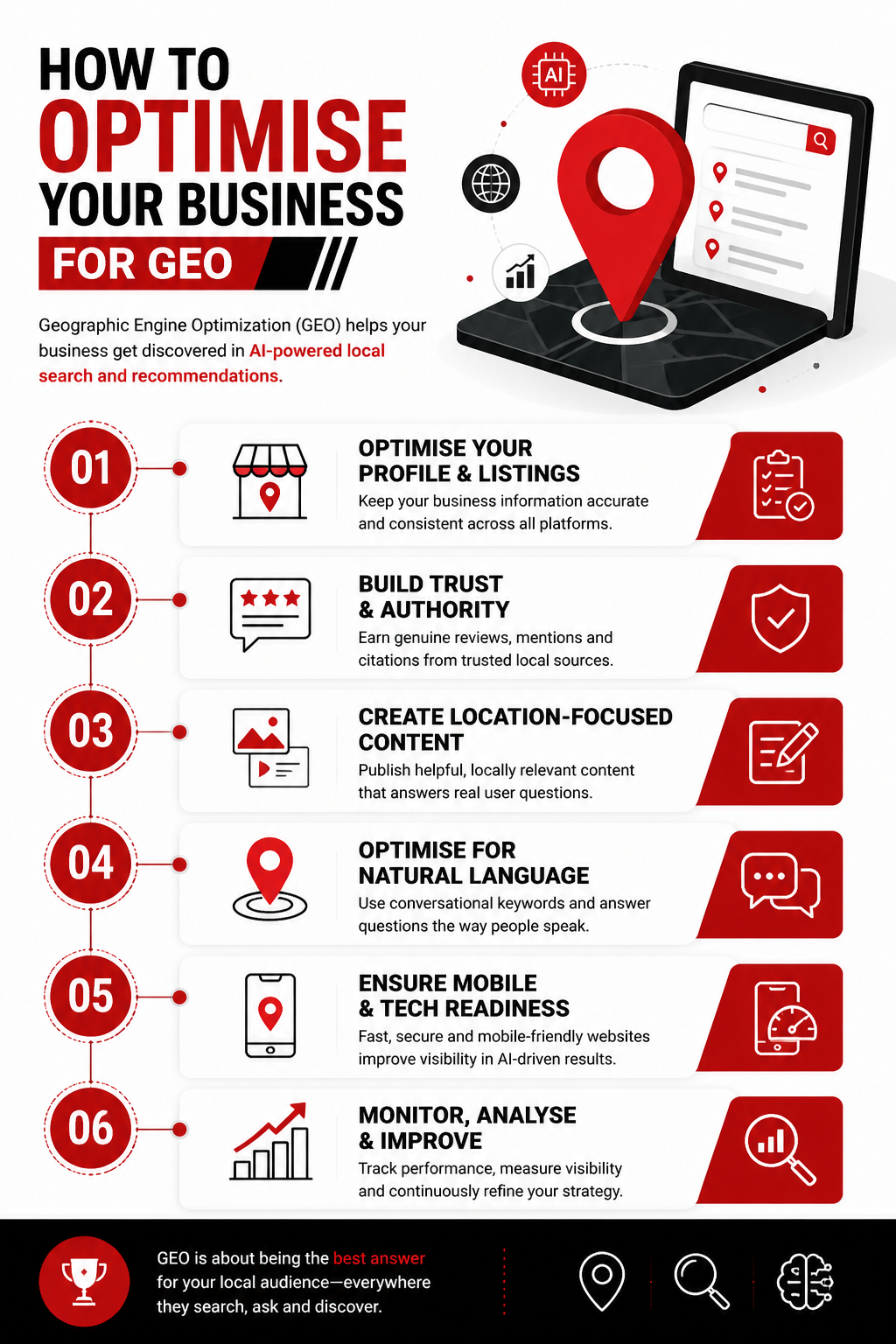
Knowing how does ai search works is the secret to winning the visibility game. AI models are pattern-matchers that value clarity, structured data, and real-world consensus.
Here is your step-by-step blueprint to ensure your business gets recommended by the best AI search engines:
1. Build Topical Authority
Stop creating isolated blog posts. Instead, develop comprehensive content hubs covering an entire subject area. AI systems favor brands that demonstrate expertise across multiple related topics.
2. Publish Original Data
AI models value unique information. Consider publishing:
- Industry surveys
- Case studies
- Benchmark reports
- Research findings
Original data increases the likelihood of being cited by AI platforms.
3. Structure Content for AI Consumption
Use: Clear H2 and H3 headings, bullet points, tables, FAQs, and concise summaries. The easier the content is to understand, the easier it becomes for AI systems to reference it.
Looking for Modern SEO Services?
Modern SEO goes beyond rankings. A strong strategy combines SEO, GEO, and AEO to improve visibility across search engines and AI platforms.
Get Your SEO Assessment4. Implement Heavy Schema Markup
Because LLMs rely heavily on organised technical code, implementing structured data is one of the most high-impact actions you can take. Use a sitewide Organisation schema, and deploy explicit Product, Service, and FAQPage schema on your high-value pages. This provides a clean roadmap for AI bots to identify your business entities.
5. Expand Your Brand Presence Beyond Your Website
AI learns from the broader web. Your brand should be visible on:
- Industry publications
- Reddit discussions
- Quora answers
- Podcasts
- Digital PR campaigns
- Expert roundups
The more credible mentions your brand earns, the more likely AI systems are to recognise and recommend it.
6. Cultivate an Off-Site Brand Footprint
AI models don't just learn from your website; they look at what the rest of the web says about you. They scrape forums like Reddit, third-party review platforms like G2 or Trustpilot, and digital PR publications.
If your brand has no digital footprint outside your own domain, AI engines simply won't know you exist to recommend you.
Conclusion
So, will AI search replace Google?
Not entirely. Google remains one of the world's most powerful information platforms, but search behavior is clearly changing. The growth of AI search, conversational interfaces, and AI-generated answers is creating a new digital landscape where visibility depends on much more than traditional rankings.
The companies that succeed will not be those chasing algorithms. They will be the businesses creating the most authoritative, trustworthy, and valuable information available online.
FAQs
1. Will AI Search Replace Google Completely?
No. AI search will transform search behavior, but Google will remain a major discovery platform.
2. What Are the Best AI Search Engines?
Popular options include ChatGPT Search, Perplexity, Claude, Gemini, and You.com for different use cases.
3. Is Traditional SEO Still Important?
Yes. SEO remains valuable, but businesses should also adopt GEO and AEO strategies.
4. Why Is My Website Getting Less Organic Traffic?
AI summaries and zero-click searches often answer questions directly without requiring website visits.
5. How Can Businesses Prepare for the Future of Search?
Build authority, publish original data, optimise for AI visibility, and strengthen your online reputation.
Spotlight GB
Editorial Team


