
AI Calling: A Complete 2026 Guide to AI Voice Agents, Uses, Costs and Limitations
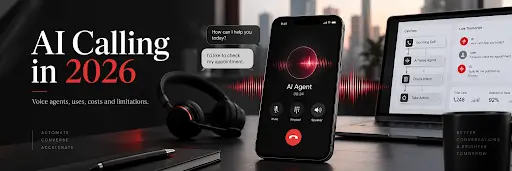
Phone calls remain important for sales, customer service, bookings, and enquiries, but businesses often struggle to answer every call quickly. AI calling uses artificial intelligence to handle inbound and outbound phone conversations, understand what people say, and respond in real time.
Unlike a basic automated menu that asks callers to “press 1” or “press 2”, an AI voice agent can hold a conversation, ask follow-up questions, collect information, and complete specific tasks based on its instructions.
The technology combines speech recognition, natural language processing, voice generation, and business workflows. When connected to tools such as a CRM or booking system, it can also take action instead of simply answering questions.
Need AI Calling for Your Business?
If your business receives regular enquiries, missed calls, or appointment requests, an AI voice agent can help handle routine conversations without requiring a member of your team to answer every call.
Explore AI Calling ServicesAI Calling: What Is It and How Does It Work?
AI calling refers to phone systems that use artificial intelligence to understand spoken language and respond to callers in real time.
Unlike traditional automated phone menus, which usually rely on fixed options such as “press 1 for sales”, modern systems can hold more natural conversations.
An AI voice agent can listen to what someone says, identify their intent, provide an appropriate response, and trigger an action when required.
The technology commonly combines:
- Speech recognition
- Natural language processing
- Conversational AI
- Text-to-speech
- Real-time voice processing
- CRM integration
- Call routing and human handoff
The exact capabilities depend on how the system is configured and which business systems it connects with.
What Is an AI Voice Agent?
An AI voice agent is software that can communicate with people through spoken conversations.
Depending on how it is configured, an AI voice agent can:
- Answer incoming calls
- Make outbound calls
- Understand spoken questions
- Provide information from approved business content
- Capture customer or lead details
- Qualify potential leads
- Book or reschedule appointments
- Send information to a CRM
- Transfer calls to a human team member
- Record useful call information for follow-up
The important point is that an AI voice agent is not simply a recorded script. Modern systems can respond to different answers and follow a conversation based on the caller's intent.
How Does AI Calling Work?
A typical conversation follows several stages.
1. The caller speaks
The system receives the caller's voice and converts the speech into information the AI can process.
2. The AI identifies intent
The conversational AI analyses the request and determines what the caller is trying to achieve. For example, the caller may want to book an appointment, ask about a service or speak to a member of staff.
3. The system generates a response
The AI selects or generates an appropriate response based on its instructions, available information, and the context of the conversation.
4. The voice agent responds
Text-to-speech technology converts the response into spoken language, allowing the conversation to continue naturally.
5. An action can be completed
Depending on the setup, the AI can schedule an appointment, collect information, update a CRM, route the caller, or transfer the conversation to a human.
This process happens in real time, which is what makes modern voice AI different from older automated telephone systems.
Where Can Businesses Use AI Voice Agents?
AI voice agents can support several parts of the customer journey.
Customer enquiries
Businesses can use voice AI to answer common questions about services, availability, opening hours, locations, and processes.
Lead qualification
An AI agent can ask predefined questions to understand a prospect's requirements before passing suitable leads to a sales team.
Appointment booking
Voice agents can help customers book, confirm, reschedule, or cancel appointments when connected to the relevant booking system.
Missed-call follow-up
Instead of leaving a missed call unanswered, businesses can use automated calling to follow up and identify why the person contacted them.
Customer support
Routine support requests can be handled automatically, while more complicated cases can be transferred to a human agent.
Outbound communication
Businesses can also use AI phone agents for reminders, confirmations, surveys, and other planned calls.
The right use case depends on the type of conversation, the information the AI needs access to, and how much human involvement is required.
Ready to Explore AI Voice Agents?
From answering incoming enquiries to qualifying leads and managing appointment calls, voice AI can support several routine communication tasks.
Explore the AI Calling Service →Why Are Businesses Exploring Voice AI?
The growth of conversational AI is not limited to experimental use cases.
Gartner reported that 85% of customer service leaders surveyed planned to explore or pilot customer-facing conversational generative AI during 2025. The same research found that organisations were also exploring voice-based applications.
For businesses, the attraction is often practical rather than purely technological. Voice AI can help manage repetitive conversations, respond outside normal working hours, and give teams more time for interactions that require human involvement.
However, automation does not automatically make every customer interaction better.
A voice system still needs clear instructions, accurate information, suitable escalation rules, and regular monitoring.
For a closer look at how voice automation compares with traditional call handling, see the guide to AI Calling Services vs Human Call Centers.
How Much Does AI Calling Cost?
There is no single price for an AI calling system.
The cost can depend on factors such as:
- Number of calls handled
- Call duration
- Inbound or outbound calling
- Voice and language requirements
- CRM integrations
- Booking or payment integrations
- Call recording and transcription
- Custom workflows
- Human handoff requirements
- Reporting and monitoring
Some providers charge according to usage, while others offer monthly plans or customised business packages.
For this reason, comparing prices based only on the headline monthly fee can be misleading. Businesses should also consider what is included, how calls are billed, and whether additional integrations or setup work cost extra.
What Are the Limitations of AI Calling?
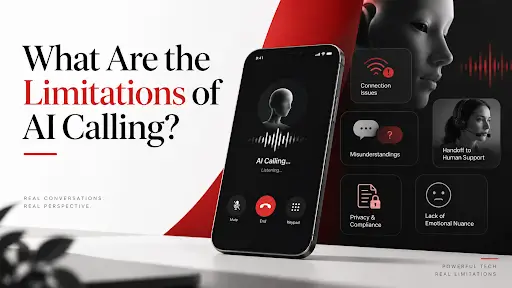
AI voice agents can handle many structured conversations, but they are not suitable for every situation.
Complex conversations
Some enquiries require detailed reasoning, specialist knowledge or information that the AI does not have access to.
Emotional situations
Customers dealing with complaints, sensitive issues or stressful situations may prefer speaking directly with a person.
Research from ServiceNow's 2025 Consumer Voice Report found that 70% of surveyed EMEA consumers expected humans to perceive emotions, compared with 42% who thought AI chatbots could do so.
This highlights an important consideration: conversational ability is not the same as human emotional understanding.
Accents, noise and unclear speech
Background noise, unusual phrasing, strong accents or poor phone connections can affect how accurately an AI system understands a caller.
Incorrect information
An AI agent needs reliable information and clear boundaries. Poorly configured systems can give incomplete or incorrect responses.
Compliance and privacy
Businesses also need to consider applicable privacy, recording, consent, and telecommunications requirements when deploying automated calling.
For these reasons, human escalation remains an important part of many AI calling strategies.
AI Voice Agents and Human Teams
The practical question is often not whether AI should handle every call, but which calls are appropriate for automation.
AI can be useful for repetitive and predictable tasks such as FAQs, appointment confirmations, initial lead qualification, and basic information gathering.
Human employees can then focus on conversations requiring judgement, empathy, negotiation or specialist knowledge.
This hybrid approach can also give customers a clear route to human support when the AI cannot resolve their issue.
For more information about natural voice interactions and customer trust, see Spotlight GB's guide to Conversational AI Calling.
What Should You Check Before Using an AI Voice Agent?
Before implementing voice AI, consider:
- Which calls should be automated?
- Which conversations must reach a human?
- What information does the AI need?
- Does it integrate with your CRM or booking system?
- How will calls be monitored?
- What happens when the AI cannot answer?
- How will customer data be handled?
- How will performance be measured?
Starting with a focused use case can make it easier to test the technology before expanding it across more customer interactions.
Need Help Planning Your AI Calling Setup?
If you're considering voice AI but are unsure which calls to automate, Spotlight GB can help you assess suitable use cases, workflows and integrations.
Contact UsConclusion
AI calling can help businesses manage routine phone conversations, respond faster, and give human teams more time for complex customer interactions.
AI voice agents can answer questions, qualify leads, book appointments, and handle other structured tasks, but they still have limitations around complex conversations, emotional situations, accuracy, and compliance.
The most useful approach is to identify where automation genuinely helps and create clear routes to human support when needed.
Frequently Asked Questions
What is AI calling?
AI calling uses artificial intelligence to manage phone conversations. Depending on the setup, it can answer questions, qualify leads, schedule appointments, route calls, and complete routine tasks.
Can AI voice agents make outbound calls?
Yes. Depending on the system and use case, AI voice agents can make outbound calls for reminders, follow-ups, surveys, confirmations, and lead qualification.
Can AI voice agents answer incoming calls?
Yes. They can answer inbound calls and handle predefined enquiries, collect information, route callers, or transfer conversations to human staff.
Can AI voice agents replace human call agents?
Not in every situation. AI can handle many routine conversations, while human agents remain important for complex, sensitive, or highly personalised interactions.
What happens when an AI voice agent cannot answer a question?
A properly configured system can be designed to escalate the conversation to a human, provide a suitable fallback response, or collect information for later follow-up.
Is AI calling suitable for small businesses?
It can be, particularly when a business receives repetitive enquiries, missed calls or appointment requests. The suitability depends on call volume, workflow complexity and the level of integration required.
Spotlight GB
Editorial Team


